Trypiti Gorge (Agios Savvas)
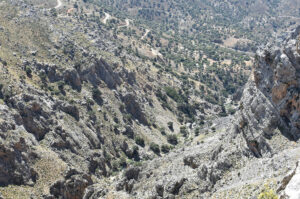
Trypiti Gorge is formed south of the settlement of Vasiliki, in the imposing Asterousia Mountains, and ends at Trypiti Beach, known for its fine pebbles and clear turquoise waters. It has a total length of approximately 4 kilometers and begins near the church of Agia Paraskevi, at an altitude of 655 meters. Its initial upper section (about 1.1 km) is technical and cannot be crossed without equipment, as waterfalls and steep passages are formed along the route. Its descent requires experience and proper training.
Further down, the gorge becomes more accessible and offers a unique experience even to those approaching it by road, as it is one of the few gorges in Crete that can be traversed by car for a large part of its length. Midway through the route, in a distinctive landscape with wild olive trees, stands the church of Agios Savvas, which gives the gorge one of its names. The olive trees here grow naturally and are not cultivated, offering visitors the image of the olive tree in its natural environment and development.
The area is also home to the characteristic and rich flora of the Asterousia range, as well as notable birdlife. Shortly before the exit to the sea lies the impressive so-called “Narrow Gorge,” where the rocks rise steeply and nearly meet, forming a passage reminiscent of the “Clashing Rocks.” The road passes narrowly between them, creating a truly striking sight. Next to the beach stands the cave church of Panagia Trypiti, also known as Protoseptemvriani. Above the eastern slope, on Papouri Hill, an important Early Minoan settlement has been identified. The presence of prehistoric installations and tholos tombs in the wider area reveals that the gorge was not only a natural passage but also a place of life from the very early years of human presence in Crete.
*The photograph is sourced from the official website of the Asterousia UNESCO MaB Biosphere Reserve._